Skip to content
Organicin Scientific Back to Organicin

The CinThesis platform

Your next product.
Starting with biology.

Find promising bacteriocins, understand the evidence, and decide what to develop next.

Work with Organicin from the first question through product development, or use CinThesis to lead your own discovery.

Two ways to work
with CinThesis.

The same discovery platform.
A different relationship with our team.

Co-development

Build with Organicin.

Fund a discovery and development program shaped around your application. Our team does the work with you, and your investment earns better licensing terms on the final product.

Your investment
Scoped discovery and development, with platform credits included in your statement of work.
Your product
Better final-product licensing terms in return for funding development.
Your team
Organicin’s expertise, plus CinThesis access for people across your organization.
Independent access

Discover on your terms.

Use CinThesis for your organization’s own discovery work, with enterprise or academic access. Everything you discover is yours, with no Organicin product license attached.

Your investment
Enterprise usage at commercial rates; academic usage at cost to support bacteriocin research.
Your discoveries
Your discoveries belong to you, with no Organicin product license.
Your team
Your organization directs its analysis using CinThesis tools and its agreed data-access tier.

In either route, your project data and reports belong to you. Your genome reports, protein reports, and associated project data belong to your organization. Final-product licensing is agreed separately in co-development.

Ownership & access

Choose a route to explore the relevant process, access, and ownership details below.

The co-development journey

Change route
Phase 0Optional

Start with your question.

A health or functional outcome can be the starting point. If your bacterial targets are already defined, you can usually move straight to discovery.

Outcome → bacterial targets → discovery

Define what to investigate.

Tell us the health or functional outcome you want to pursue. Organicin can help identify the bacterial targets that make sense for that objective and establish the scope of discovery.

Then move into discovery

Defined bacterial targets → discovery

Begin with the targets you know.

Bring one bacterial target or a set of targets. With the target and intended use already defined, your project can usually start at Phase 1.

Go to Phase 1
Phase 1The core CinThesis platform

From a genome
to a decision.

CinThesis turns whole-genome data into candidate-level evidence and a comprehensive view of the strain. In co-development, our team turns those findings into a shortlist for your application.

Discovery produces computational predictions and research-backed assessments. Product development tests those findings experimentally.

01Research the target. Screen the genomes.Find the candidates worth bringing into the platform.
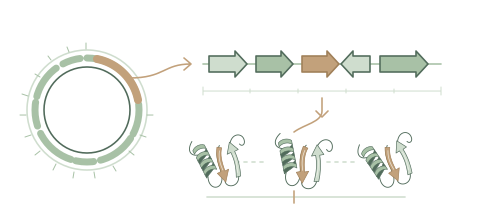
A selected genome region leads to a gene cluster and candidate proteins.
Whole genome gene clusters candidates

For Organicin-led discovery, our team performs preliminary research, sources relevant whole-genome sequences (WGS), and submits them for screening against the agreed project scope.

The genome-screening system examines biosynthetic gene clusters: groups of genes associated with making biological products. It identifies the associated candidate proteins and submits the selected set for deeper analysis.

Within CinThesis, this screening is handled by the BGC analysis system (BGC VM).

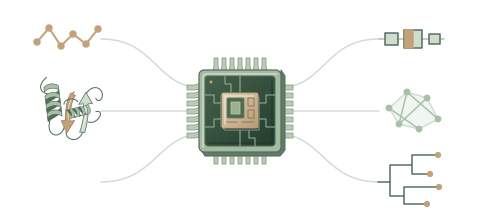
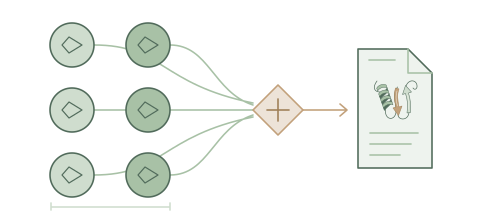
02Build each candidate’s molecular profile.Examine the protein through six complementary perspectives.
Six molecular perspectives connect to a central analysis chip: primary sequence, secondary structure, predicted 3D structure, domains, embeddings, and evolutionary context.
Select a perspective below to locate it in the illustration.
800+

Inputs to our machine-learning model, built from six complementary views of each candidate.

This profile also helps assess whether a candidate could become a practical product.

Could it work in your formulation?
Sequence and molecular properties provide clues about solubility and stability, helping prioritize candidates for heat-tolerance and shelf-life testing.
How might it act?
Domain architecture identifies functional regions that help explain a candidate’s possible mechanism of action.
What can related proteins tell us?
Evolutionary context connects the candidate to known bacteriocins and their literature, helping inform predictions about which bacteria it may inhibit.

These are development hypotheses. Product stability, shelf life, and activity are established through experimental evaluation.

03Connect the findings to what is known.Bring research, biological records, and molecular evidence together.
The CinThesis Compendium supplies reference evidence to research agents through Armamentarium. Agents combine this evidence with the candidate’s molecular profile to craft reports.
Compendium300,000+ articles
& biological records
Research agentsSearch, connect
& interpret findings
ReportsCandidate evidence,
explained in context
Via CinThesis Armamentarium

The tools agents use to search the Compendium and retrieve relevant evidence.

Raw analytical dataBiological interpretation
Integrated assessment

The CinThesis Compendium is the reference library behind the research: more than 300,000 research articles alongside structured records for inhibitory profiles, genes, genomes, and protein sequences.

Research agents access this library through CinThesis Armamentarium, our research and analysis tool suite. They search the literature, query biological records, and connect the retrieved evidence with each candidate’s molecular profile to craft the biological interpretation in its reports.

This is the proteosemantic layer. Both its research-informed interpretation and the original analytical data feed into the integration layer for prediction and final protein-report generation.

04Assess every candidate. Create its report.Combine machine learning with agentic assessment.
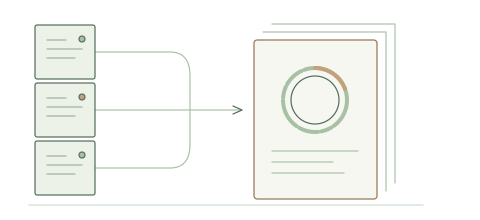
Six model nodes converge into a combined assessment and a candidate report.
Six models contribute to one combined prediction.

The integration layer combines the raw profile and proteosemantic interpretation for each candidate submitted by genome screening.

  1. Machine-learning prediction using a 6-model ensemble.
  2. An initial agentic assessment.
  3. Promotion for further review when flagged.
  4. Formal agentic prediction and protein-report generation.

Each candidate receives its own report. This process repeats across the full submitted candidate set.

05Bring the whole genome into view.Connect candidate reports, bacteriocin enrichment, and strain context.
Individual candidate reports connect to a comprehensive genome report.
Individual proteins, understood in the context of a genome.

Once reporting is complete for all submitted candidates, bacteriocin candidates receive further analysis of their biosynthetic gene clusters and predicted inhibitory spectra: the bacteria they may act against.

CinThesis then analyzes the genome comprehensively, incorporating the complete candidate set and the genome’s broader context into a genome report. Its protein and bacteriocin reports remain connected to that larger picture.

06Choose what to develop next.Expert selection and a written handover for co-development partners.
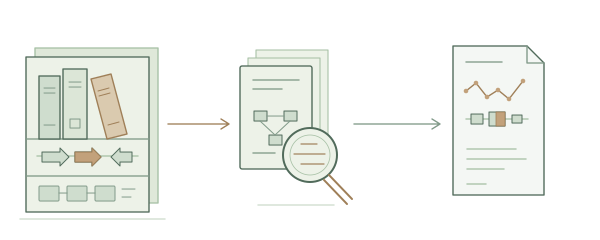
Candidate shortlistExpert reviewYour project report

Organicin reviews the relevant reports and data, performs additional research, and uses Atlas, Genome Explorer, Structure Analysis, and other CinThesis tools to assess the best candidates for your use case.

Co-development partners receive a shortlist of genomes and bacteriocin candidates, plus a written account of the work, results, selection rationale, recommendations, next steps, and the team’s supporting manual research.

The workspace behind the process

Explore genome reports, protein evidence, the strain assistant, and Atlas in the recorded platform walkthrough.

Inside CinThesis.

Watch the complete walkthrough, or choose a chapter.

7:27 walkthrough

Loading the laptop walkthrough…

Your work.
Your workspace.

Project ownership, shared reference access, and custom tools are defined clearly around your organization.

Your data and reports

Your organization owns its project data, genome reports, and protein and bacteriocin reports.

The team’s final project write-up is kept securely in your documents section in the CinThesis portal. Your organization’s agents can also access the document’s content.

Your project outputs are separate from the shared reference library available through your access tier.

Credits for your organization

Your co-development SOW includes platform credits that anyone in your organization can use to submit genomes and carry out their own analysis with the CinThesis tool suite.

The shared-data access available to those tools and agents is negotiated in the same SOW.

A shared library. Four levels of access.

Confirmed bacteriocin entries, with their related genes, genomes, inhibitory profiles, and literature.

  1. Basic10confirmed bacteriocins
  2. Extra50confirmed bacteriocins
  3. Premium100confirmed bacteriocins
  4. Full752confirmed bacteriocins

Cumulative access: each level includes the entries available in the levels before it. Your tier is agreed in the SOW.

How shared-data access works

Your shared-data tier determines which reference entries, associated records, and existing reports your tools and agents can consult.

Work performed by Organicin

Reports and subsequent expert analysis performed for you by Organicin always use full shared-data access.

Your organization’s own analysis

Independent use by members of your organization follows its agreed access tier, including analysis paid for with credits in a co-development SOW.

Custom tools: co-developed or private

Atlas, Genome Explorer, and Structure Analysis are part of a wider tool suite. Custom modules can also be developed around your project’s questions.

Co-developed modules

The module becomes a tool Organicin can reuse across its work.

Privately commissioned modules

Your organization has exclusive access. Organicin may use the module only for your projects.

Co-development beyond discovery

Move forward
with the evidence.

Development is divided into agreed stages. Review the results together and decide whether to continue. You can choose to stop co-development at any stage if the project is no longer warranted.

Phase 2

Product development.

Test the discovery predictions and develop the candidate for its intended use. Organicin sources the relevant biological materials, coordinates any required permits, and carries out the agreed validation and development work.

Inhibitory activity and minimum inhibitory concentrations (MICs) are assessed against the selected targets. You review the results with us before deciding whether to continue, expand the search, or stop.

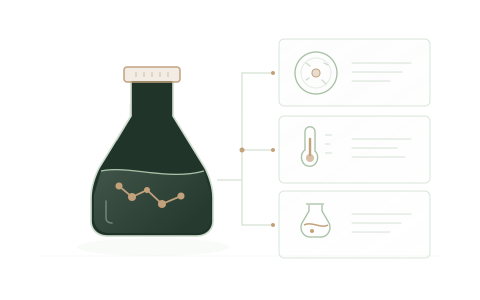
A candidate sample connects to activity, stability, and formulation assessment panels.
Activity. Stability. Formulation.
See example development milestones
  1. 2.1

    Confirm activity

    Evaluate inhibitory profiles and MICs against the agreed bacterial targets.

  2. 2.2

    Confirm candidate materials

    Assess activity in early candidate preparations and carry out initial purification.

  3. 2.3

    Assess stability

    Determine whether the candidate’s stability supports the intended application.

  4. 2.4

    Develop the formulation

    Explore how the candidate can be prepared for its intended product use.

These are examples. The number, sequence, and scope of stages are decided together.

Phase 3

Scale-up.

Turn a promising candidate into a practical, repeatable production process. Together, we define the quality, quantity, and cost requirements for your intended product.

The work can include process design and optimization, production planning, and genetic engineering where it is appropriate and agreed for the project.

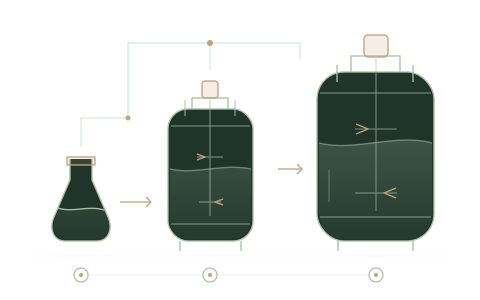
Increasing production-vessel sizes share a quality-review line.
From a candidate to consistent production.
Design the production route
Translate development findings into a process suited to the product and the scale you need.
Establish consistency
Evaluate whether the process can deliver material with the required identity, quality, and activity as production grows.
Plan for practical manufacture
Assess production costs, material requirements, and the documentation needed to support a manufacturing handover.

Your next decision: whether the production approach supports the product’s quality and commercial goals.

Phase 4As needed

In vivo & preclinical.

Build the evidence needed to understand how the candidate performs in a setting relevant to its intended use. This phase is included when the product and project objectives call for it.

We agree the questions the studies need to answer, the appropriate research setting, and the specialist capabilities required. The plan connects evidence of benefit with safety and tolerability.

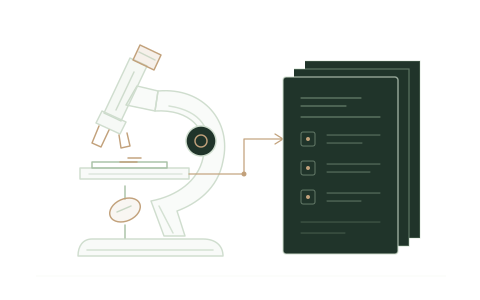
A laboratory microscope and slide connect to an organized study-evidence dossier.
Study evidence, organized for review.
Define the evidence needed
Identify the remaining questions about performance and safety for the intended application.
Coordinate the study program
Scope suitable studies with the appropriate research partners, review requirements, and agreed decision points.
Review the findings together
Bring the results into a clear evidence package and identify what supports further development or requires more work.

Your next decision: whether the evidence supports moving the product forward, and what gaps remain.

Phase 5

Regulatory & go to market.

Bring the product, evidence, and commercial plan together. The intended use, proposed claims, and launch markets determine the regulatory work that needs to be scoped.

We work with you to plan the required documentation and specialist input, while aligning manufacturing readiness, commercial partners, and the final product’s agreed licensing terms.

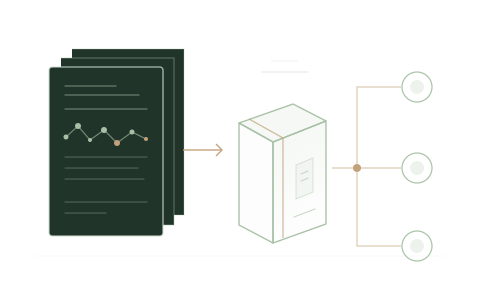
An evidence dossier leads to a packaged product and a distribution network.
Evidence to product. Product to market.
Map the route to market
Define the product category, intended claims, launch geography, and the evidence or submissions each requires.
Assemble the product dossier
Organize the relevant development, quality, and safety evidence for regulatory review and commercial due diligence.
Prepare for launch
Align supply, product specifications, partner responsibilities, and licensing so the commercial plan can move forward.

Your destination: an agreed market-entry plan, with the evidence, responsibilities, and remaining requirements clearly defined.

Let’s define the right starting point.

Bring us your question.

An outcome, a bacterial target, or a project already in motion. Start a conversation about a co-development project.

Discuss your project